
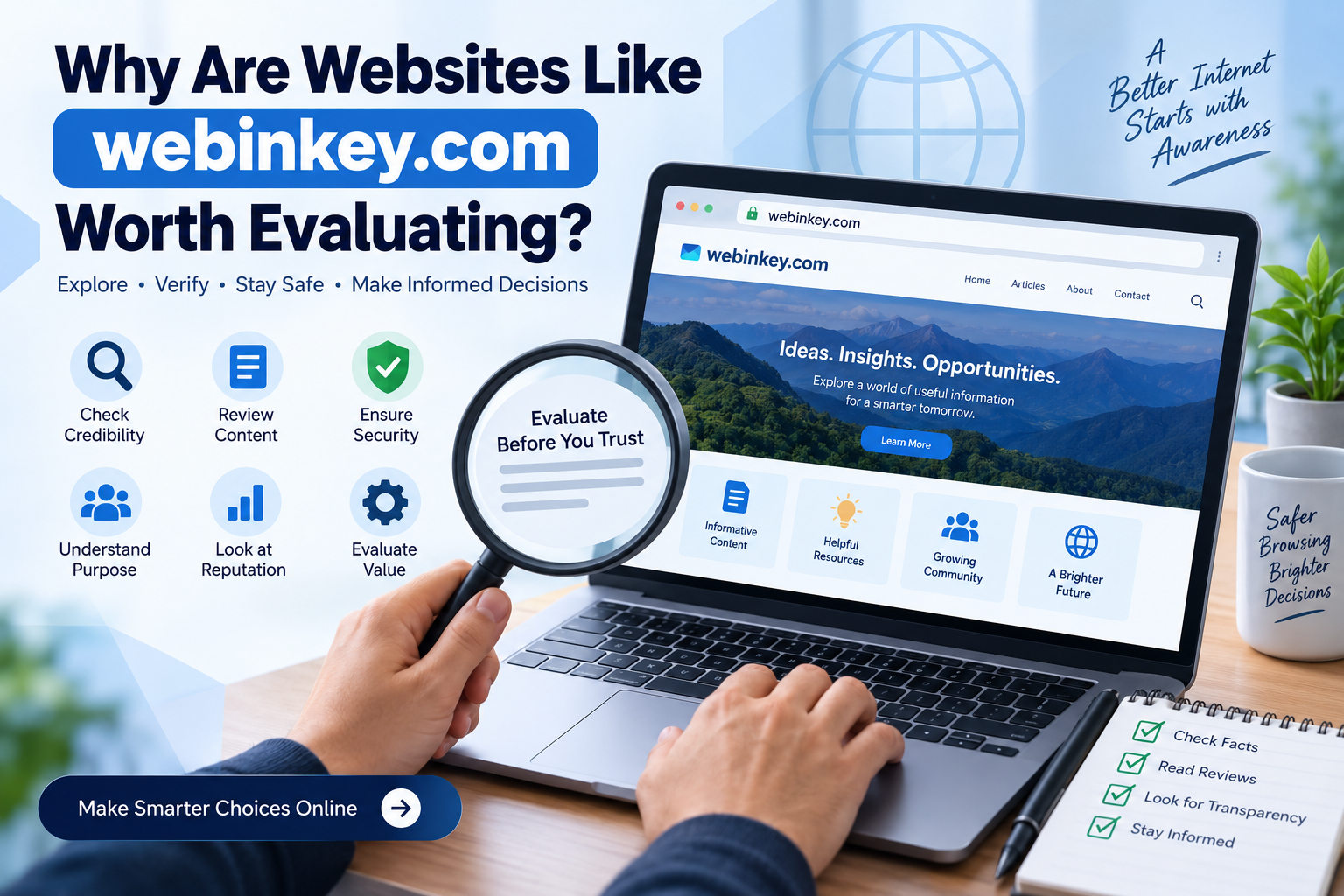
The internet is filled with websites offering different services, resources, and digital experiences. Some platforms focus on entertainment, while others provide information, online tools, or business-related solutions. As new domains appear, users often search for websites such as webinkey.com to understand their purpose, features, and potential value.
Evaluating a website before using it is an important online habit. It helps users understand what a platform offers, identify possible risks, and decide whether it meets their needs.
In this article, we explore why websites like webinkey.com are worth evaluating, which factors deserve attention, and how users can make more informed decisions when exploring unfamiliar online platforms.
Note: The specific services, ownership, and current functionality of webinkey.com should be verified through the website itself and reliable external sources. The discussion below focuses on general website evaluation rather than unverified claims about this domain.
1. Understanding the Purpose of a Website
One of the first reasons to evaluate a website is to understand what it actually offers. A domain name alone does not explain whether a platform provides reliable information, digital services, business resources, or entertainment.
Websites with names such as webinkey.com may attract visitors through search engines, recommendations, or online discussions. However, users should examine the website’s actual content and services instead of relying only on its name.
Questions to Consider
Before using an unfamiliar website, ask:
- What is the primary purpose of the platform?
- What type of content or services does it provide?
- Who is the intended audience?
- Does the website explain its services clearly?
- Are the published claims supported by reliable information?
Answering these questions helps users establish whether the website is relevant to their needs.
2. Evaluating Website Credibility
Credibility is an important factor when assessing any online platform. A website may have a professional design, attractive content, and an active appearance, but these characteristics alone do not establish reliability.
Some online sources describe webinkey.com as a broad content publication, while others associate it with digital services. These descriptions are inconsistent, so readers should verify the website’s actual identity through first-party information and independent sources. (Gizmo Crunch)
Important Credibility Indicators
| Evaluation Factor | Why It Matters |
|---|---|
| About Us page | Explains the website’s purpose and background |
| Author information | Helps readers understand who created the content |
| Contact details | Provides a way to communicate with the website |
| Supporting references | Helps verify factual claims |
| Editorial guidelines | Explains how content is reviewed |
| Independent reputation | Provides additional context beyond the website’s own claims |
These factors are useful for evaluating webinkey.com and other unfamiliar websites.
However, the absence of one feature does not automatically prove that a website is fraudulent. Users should consider multiple signals together.
3. Discovering Useful Information
Websites that cover different subjects can help users explore unfamiliar topics. A general information platform may publish articles about technology, business, education, lifestyle, and other areas.
This format can be useful for readers who want introductory explanations or ideas for further research.
For example, someone exploring digital marketing might use an online article to learn about:
- Search engine optimization
- Content marketing
- Website development
- Social media strategies
- Online business practices
However, readers should distinguish between introductory information and expert guidance. Articles about complex subjects may require additional research from established organizations, official documentation, or qualified professionals.
Why Verification Matters
Information found online can become outdated or may contain incomplete explanations. Checking publication dates, reviewing references, and comparing information across trusted sources can help reduce the risk of relying on inaccurate material.
This is particularly important for health, finance, legal matters, and other topics where incorrect information can lead to serious consequences.
4. Assessing Website Design and User Experience
Website design is another reason to evaluate platforms like webinkey.com. A website’s structure can influence how easily visitors find and understand its content.
A well-organized website generally makes navigation more convenient by providing clear menus, readable text, and logical categories.
Design Features Worth Checking
Mobile responsiveness:
The website should display properly on smartphones, tablets, and desktop computers.
Navigation:
Menus and internal links should help visitors find relevant pages without unnecessary difficulty.
Readability:
Clear typography, appropriate spacing, and organized headings can improve the reading experience.
Page performance:
Slow-loading pages may make it difficult for visitors to access information.
Accessibility:
Readable text, suitable contrast, and descriptive links can make websites more usable for different audiences.
These design principles apply broadly and should not be interpreted as confirmed findings about the current webinkey.com website.
5. Checking Website Security
Security should be considered whenever someone visits an unfamiliar website or considers using its services.
A secure connection, commonly indicated by HTTPS, helps encrypt data transferred between a browser and a website. However, HTTPS does not guarantee that a website’s content, business practices, or third-party links are trustworthy.
Users should remain cautious when a website requests sensitive information.
Basic Security Practices
- Avoid sharing passwords or sensitive account details unnecessarily.
- Do not provide payment information unless the service and business identity have been verified.
- Be careful when downloading unfamiliar files.
- Review external links before opening them.
- Use reputable security software and keep your browser updated.
If a website claims to offer a service, verify its terms, contact details, and refund policies before making a payment.
6. Evaluating the Value of Online Content
Another reason to assess a website is to determine whether its content provides meaningful value.
Not every article needs to be highly technical or lengthy. Sometimes users need a simple explanation of a topic. In other situations, they may require detailed evidence, professional expertise, or current data.
The value of a website depends on how well its content matches the reader’s needs.
Questions for Evaluating Content Quality
- Does the article answer the main question?
- Is the information clear and logically organized?
- Are important claims supported by evidence?
- Does the content distinguish facts from opinions?
- Is the information current?
- Does the article provide practical value?
A website that publishes content across multiple categories may be useful for general exploration. However, broad coverage does not automatically establish expertise in every subject.
7. Understanding the Difference Between Website Types
Before evaluating webinkey.com, users should identify which type of platform they are dealing with.
Websites can serve different purposes, including:
| Website Type | Main Purpose |
|---|---|
| Information blog | Publishes articles and explanations |
| Business website | Promotes products or professional services |
| Digital publication | Shares news, features, and editorial content |
| Online tool | Provides specific digital functionality |
| Guest-posting platform | May offer content publication or marketing placements |
Identifying the website category makes the evaluation process more focused.
For instance, the factors used to assess an informational blog may differ from those used to assess a company selling web development services. A business website requires additional attention to service agreements, client examples, pricing, and business identity.
Available third-party descriptions of webinkey.com vary, making direct verification particularly important before assigning it to a specific category. (Gizmo Crunch)
8. Considering the Website’s Reputation
Online reputation can provide useful context, but it should not be evaluated through a single review or rating.
When researching a domain, users may encounter articles, discussions, and business listings that describe the website differently. These sources can help identify questions for further investigation, but their claims should be checked independently.
What to Look For
Independent mentions:
Look for references from sources that are not directly controlled by the website.
Consistent information:
Compare descriptions of the website’s purpose, services, and identity.
Customer experiences:
If the website offers paid services, look for genuine and verifiable customer feedback.
Transparent business information:
Check whether the operator provides clear contact and service details.
A website’s reputation should be understood through evidence rather than assumed from promotional language.
9. Evaluating Webinkey.com Before Using Paid Services
If someone is considering webinkey.com for digital marketing, publishing, or another paid service, additional checks are appropriate.
Before making a purchase, users should understand exactly what is being offered and what they can reasonably expect in return.
Recommended Checks
- Confirm the service description on the official website.
- Request clear pricing and service terms.
- Ask whether deliverables are guaranteed or estimated.
- Check whether refunds or cancellations are explained.
- Research the provider’s business identity.
- Avoid paying solely because of claims about traffic, rankings, or popularity.
For SEO professionals and website owners, it is particularly important to evaluate the quality of a potential publication or backlink opportunity through independently verifiable evidence.
A website’s domain authority or promotional claims should not be treated as proof of genuine audience engagement.
10. Protecting Your Time and Personal Information
Website evaluation is not limited to technical security. It also involves protecting personal resources, including time, money, and information.
Visitors should consider whether a website provides enough transparency to justify continued engagement.
For example, if a platform has unclear ownership, vague service descriptions, or unsupported claims, users may choose to conduct additional research before proceeding.
This approach does not require assuming that the website is unsafe. Instead, it encourages users to make decisions based on available evidence.
A Practical Approach
Before using an unfamiliar website:
- Read its main pages.
- Identify the services or content it provides.
- Review its privacy policy and terms where available.
- Check independent information.
- Avoid sharing sensitive data unnecessarily.
- Make decisions according to the level of verified information.
This process can be applied to many websites, regardless of their industry.
11. Comparing Webinkey.com With Other Websites
Comparing websites can help users understand differences in transparency, usability, and purpose.
However, a meaningful comparison requires consistent criteria. Comparing an informational blog with an online software tool using the same expectations may produce misleading conclusions.
Consider the following evaluation framework:
| Criteria | Questions to Ask |
|---|---|
| Purpose | Does the website clearly explain its function? |
| Content | Is the information relevant and useful? |
| Transparency | Are ownership and contact details available? |
| Security | Are reasonable safety practices in place? |
| Usability | Is the website easy to navigate? |
| Reputation | Is there independent evidence of its credibility? |
Using a consistent framework allows users to make their own informed assessments without relying entirely on marketing claims.
12. Common Mistakes to Avoid When Evaluating Websites
Many users make quick assumptions based on a website’s appearance or search engine position. These assumptions can lead to inaccurate conclusions.
Mistake 1: Assuming a Professional Design Guarantees Trust
A polished website can create a positive first impression, but visual quality does not establish factual accuracy or business legitimacy.
Mistake 2: Relying on a Single Review
One review may not represent the complete picture. Consider multiple sources and verify important claims.
Mistake 3: Sharing Information Too Quickly
Visitors should avoid providing personal or payment details until they understand who operates the website and why the information is required.
Mistake 4: Confusing Search Visibility With Authority
A website appearing in search results does not automatically mean its content has been independently verified.
Mistake 5: Ignoring the Intended Purpose
A website may be suitable for casual reading but inappropriate for professional or high-stakes decisions. Evaluate it according to how you plan to use it.
13. A Simple Checklist for Evaluating webinkey.com
The following checklist can help readers organize their research.
| Checklist Item | Status to Verify |
|---|---|
| Website purpose | Confirm through first-party information |
| Ownership | Check available business details |
| Content quality | Review articles and supporting references |
| Security | Assess basic website and browsing safety |
| Reputation | Research independent sources |
| Services | Verify actual offerings and terms |
| Privacy | Review information collection practices |
| Payment safety | Confirm provider identity before paying |
This checklist is designed as a practical guide rather than a verified audit of webinkey.com.
Conclusion
Websites like webinkey.com are worth evaluating because users need to understand the purpose, quality, and reliability of online platforms before relying on them. Whether someone is looking for information, exploring digital services, or researching a website for professional purposes, careful evaluation can support better decisions.
A website’s design, content, security features, and online reputation all contribute to the evaluation process. However, no single factor provides a complete picture. Users should combine direct observation with independent verification and avoid making assumptions based only on promotional claims.
For webinkey.com specifically, publicly available descriptions are inconsistent, so confirming the website’s current purpose and services through reliable first-party information is important. (Gizmo Crunch)
By developing good website evaluation habits, internet users can explore new platforms more confidently while protecting their information, time, and financial resources.
Frequently Asked Questions
1. Why should users evaluate websites like webinkey.com?
Evaluating a website helps users understand its purpose, content quality, security considerations, and credibility before relying on it or using its services.
2. What should I check before using webinkey.com?
Review the website’s purpose, ownership information, content, privacy practices, and any service terms. Verify important claims through independent sources.
3. Does a professional website design guarantee reliability?
No. A professional design can improve user experience, but it does not prove that the website’s content or services are trustworthy.
4. Why is website credibility important?
Credibility helps users determine whether information or services deserve their trust. Important claims should be verified through reliable evidence.
5. Can the same evaluation process be used for other websites?
Yes. The same basic framework—including purpose, transparency, security, usability, and reputation—can be applied to many different online platforms.